The more time I spend working with Cloudflare, the more obvious it becomes: the Internet, as we know it, isn’t something that just exists—it’s something that has to be constantly rebuilt, protected, and optimized. And Cloudflare is one of the few companies doing that work at global scale, while keeping a surprisingly simple experience on the surface.
That mission—help build a better Internet—sounds big and aspirational, but when you start looking at the platform from the inside, it becomes very concrete. Cloudflare isn’t just adding more products; it’s removing layers of friction that used to slow down teams, complicate architectures, and expand attack surfaces.

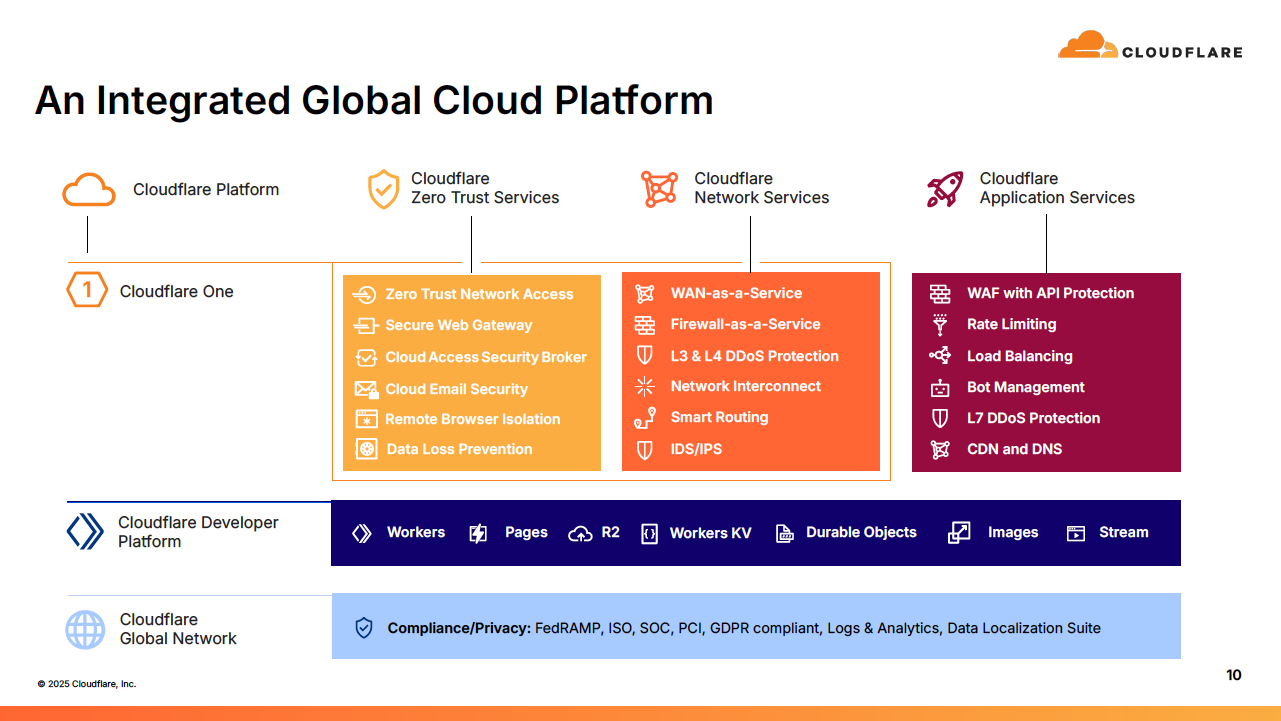
What makes Cloudflare different is how holistic and coherent the platform feels. Instead of juggling five or ten vendors to handle Zero Trust access, email security, network firewalls, DDoS protection, CDN, API shielding, storage, and developer workloads, Cloudflare builds all of this on a single global network—with one control plane, one UX, one pricing logic, one deployment model.
The result is quietly transformative:
- Security teams get Zero Trust access without tunneling gymnastics.
- Network teams get enterprise connectivity without boxes or MPLS legacy.
- Developers deploy code globally without thinking about regions, servers, or scaling rules.
And all of it runs on the same infrastructure. It’s the opposite of the “accidental complexity” that has defined enterprise IT for decades.
The network behind all this is massively distributed—more than 330 cities, 13,000 networks directly connected, and milliseconds away from almost every connected human on the planet. That proximity changes everything: performance becomes predictable, routing becomes smarter, attacks are absorbed before they reach origin, and global users feel like they’re sitting next to the application.
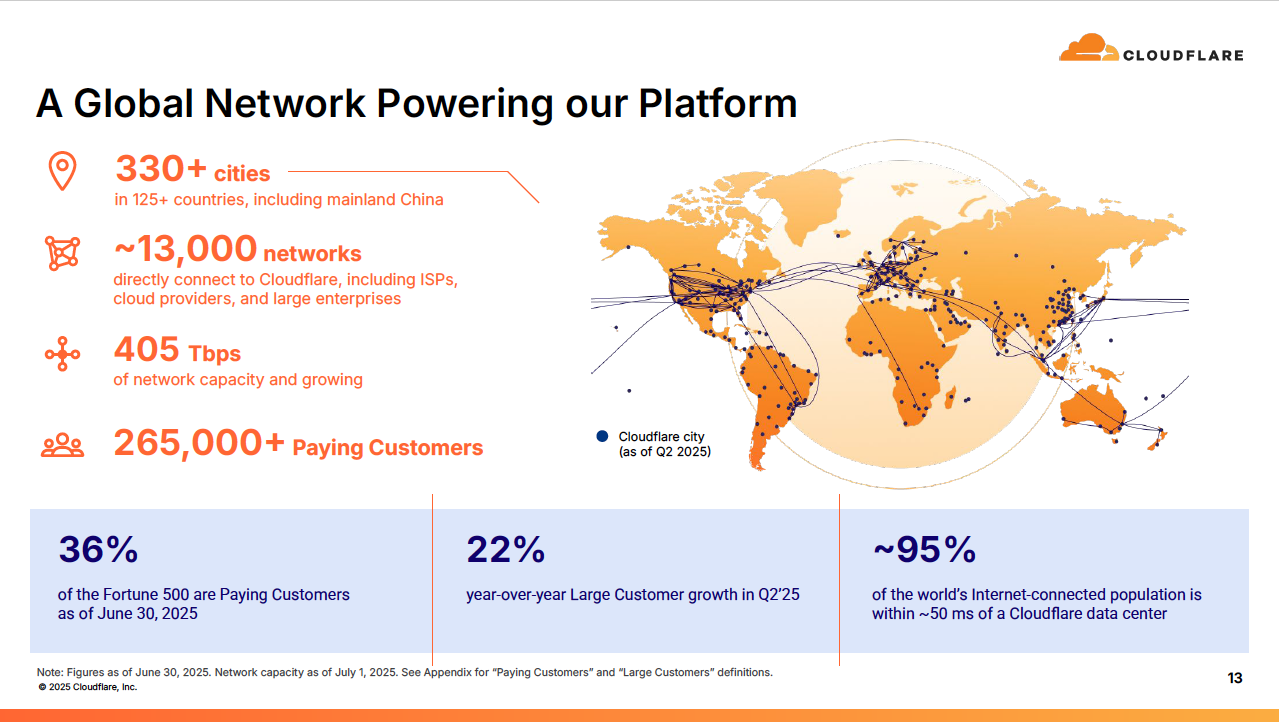
There’s real power in this kind of reach. Not just for speed, but for resilience, privacy, and the ability to innovate without geographic or architectural constraints.
When 36% of the Fortune 500 rely on Cloudflare, it isn’t because of a single feature. It’s because the network behaves like an extension of their own infrastructure—only faster, more secure, and infinitely easier to maintain.
One of the ideas that best captures Cloudflare’s value is its “flywheel”:
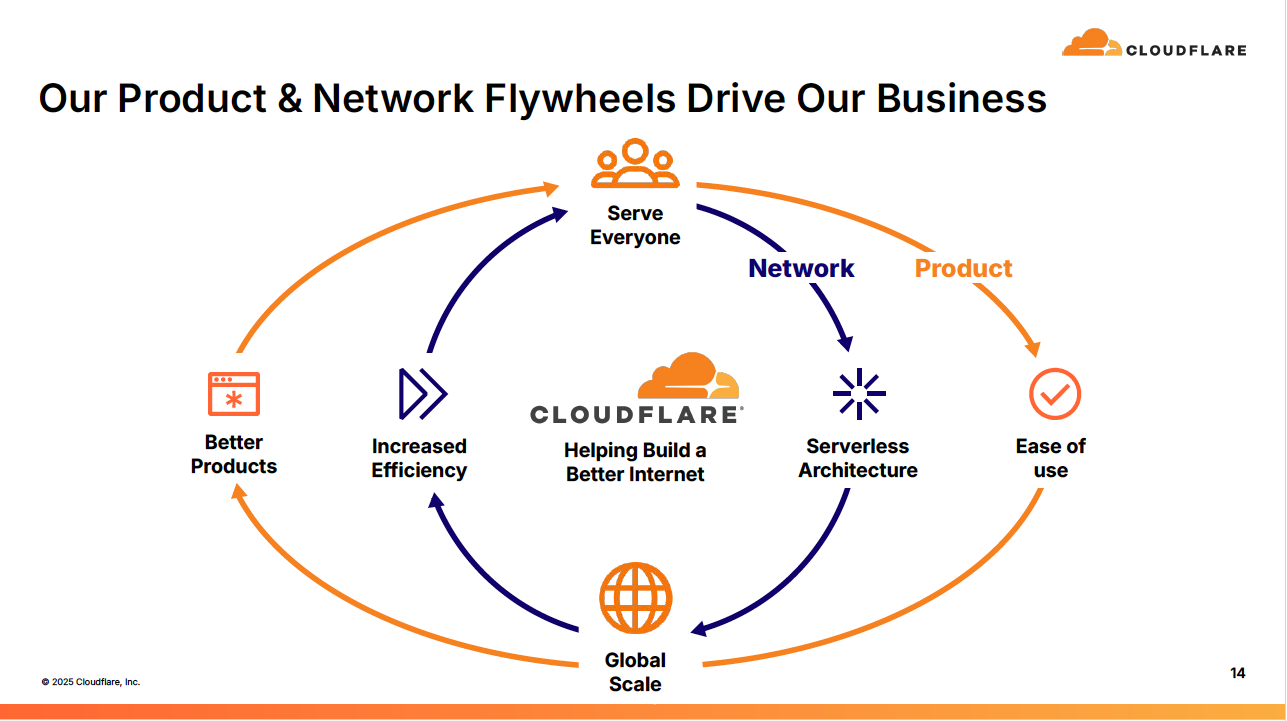
- Every new product strengthens the network.
- Every new customer improves the intelligence feeding security systems.
- Every optimization reduces latency and cost for everyone else.
It’s a rare case where scale doesn’t increase complexity—it reduces it. Customers don’t feel like they are buying disconnected tools; they feel like they are joining a system that gets better the more people use it.
And that—honestly—is a refreshing change in a world where most cloud architectures grow heavier and harder to manage as they expand.
When I look at Cloudflare’s competitive advantages, I see four that truly matter: an unparalleled network footprint, a user experience designed for clarity rather than control panels full of noise, shared threat intelligence that protects everyone collectively, and a philosophy that refuses to force customers into false trade-offs.
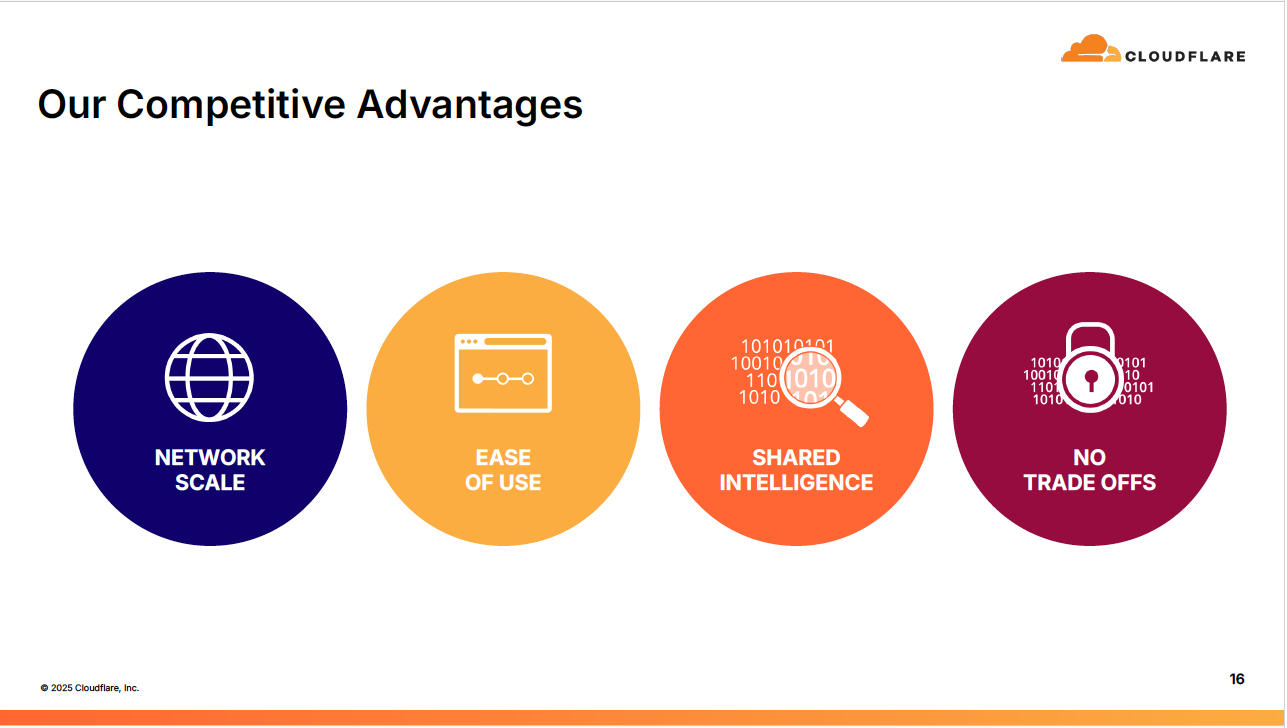
With Cloudflare:
- Performance doesn’t come at the expense of security.
- Security doesn’t make the platform slower.
- Simplicity doesn’t limit power.
- And global scale doesn’t require global headaches.
This balance is rare. And it’s the reason why Cloudflare feels less like a vendor and more like an architectural foundation—something you build on, rather than something you bolt on.