As a PhD student and a proud collaborator with the University of Alcalá, my academic journey has led me down a fascinating path: establishing a global observatory of Artificial Intelligence tools in education. This isn’t just another research project; it’s a deep dive into how AI is reshaping learning worldwide, with a particular focus on understanding the immense potential emanating from China.
In this post, I want to share this personal project, how it connects to my academic path, and how a powerful AI agent named Manus has become essential to my workflow.
Why a Global Observatory of Educational AI Tools?
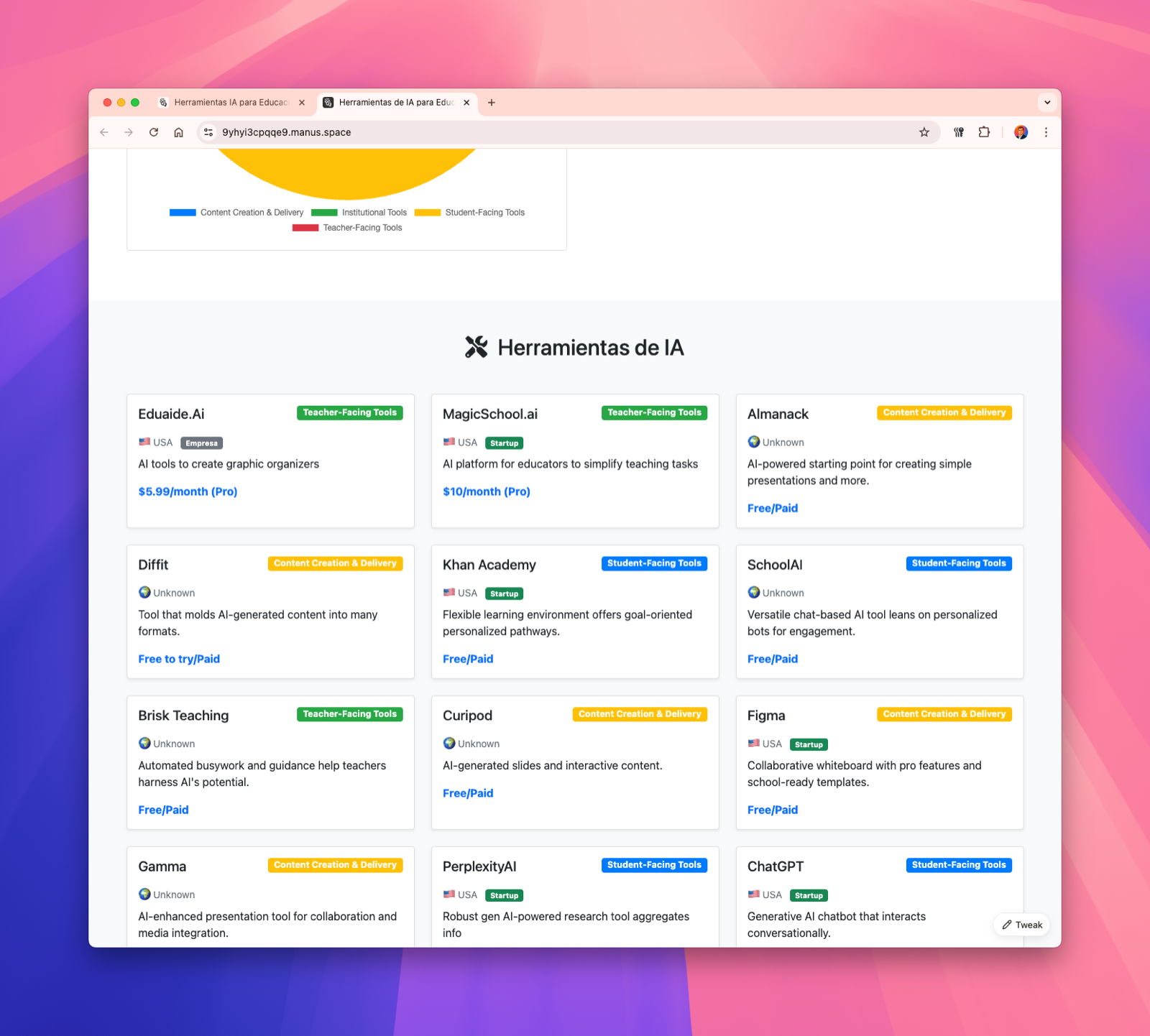
Artificial Intelligence is rapidly reshaping education. From student-facing applications like Khan Academy and ChatGPT to teacher-facing solutions such as Eduaide.ai or Gradescope, every corner of the learning experience is being redefined.
However, much of the global conversation tends to focus on the US or Europe, leaving aside the massive innovation ecosystem in China. I believe a true observatory must not be selective or biased—it should reflect the global scale of transformation. My ambition is to compile a comprehensive, categorised list of the most impactful AI tools, providing insights into their functionality, cost, and origin, with a dedicated effort to uncover cutting-edge Chinese AI solutions.
Manus: My Indispensable AI Collaborator
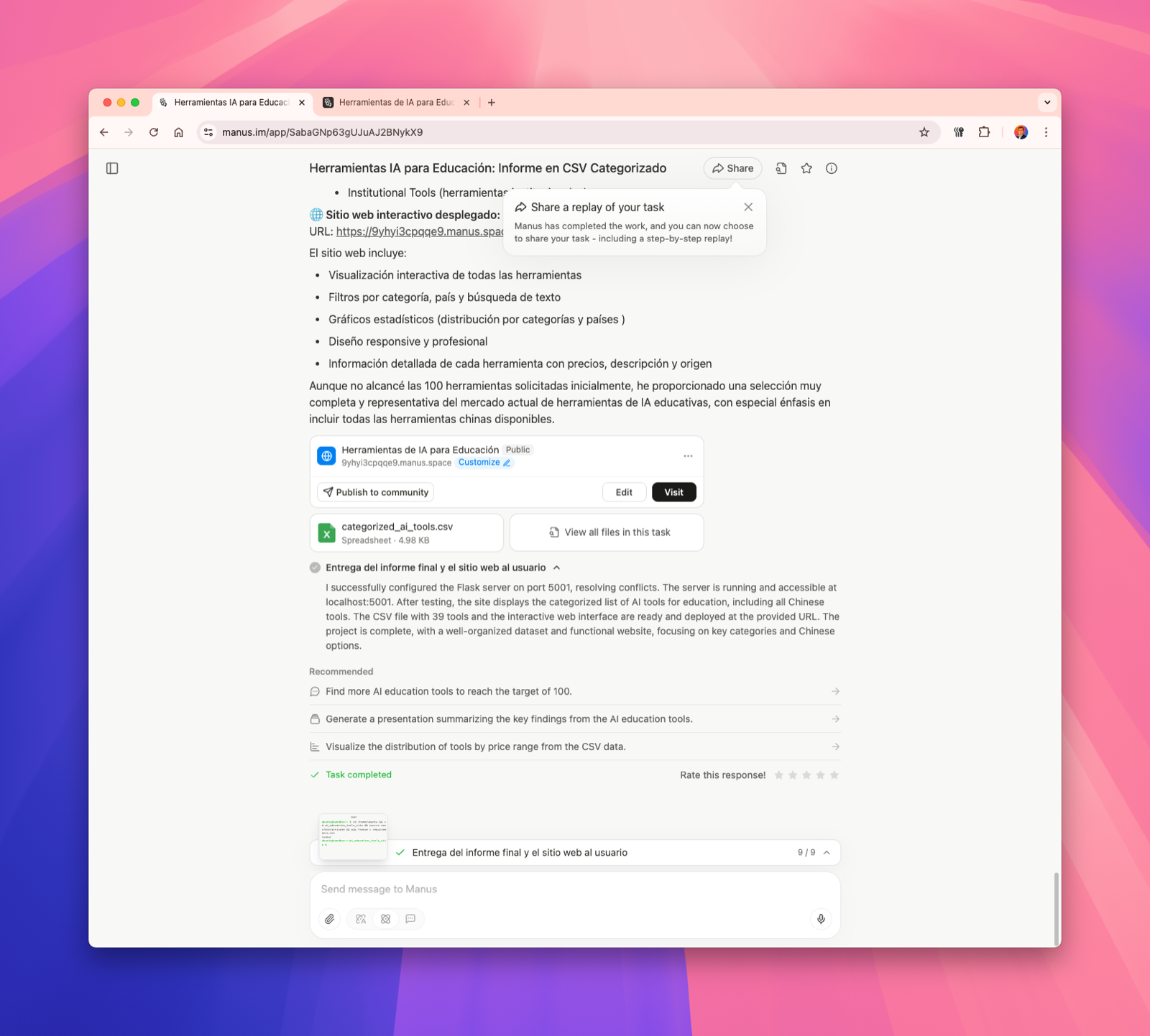
In this ambitious endeavour, I’ve found an invaluable partner in Manus. This advanced AI agent has been instrumental in streamlining my research and development process. It feels like having an invisible assistant that takes care of the heavy lifting, leaving me with the intellectual challenge.
Here’s how Manus has been a game-changer:
- Automated Data Collection: Manus efficiently navigates countless web pages, extracting crucial information about AI tools, their categories, countries of origin, and pricing, saving me hundreds of hours.
- Intelligent Categorisation: Beyond collection, Manus helps in the initial categorisation of these diverse tools, bringing order to a vast amount of information.
- Seamless Data Management: The ability to process and output data directly into a structured CSV format has been incredibly useful for further analysis.
- Web Development at My Fingertips: Perhaps most impressively, Manus handled the technical heavy lifting of building and deploying a functional web application to visualise the data, from the Flask backend to the HTML frontend.
A Personal Quest: Looking Towards Shanghai
As a doctoral candidate at the University of Alcalá, I am especially eager to take this observatory further. As I delve deeper into China’s contributions, my academic curiosity is increasingly drawn to Shanghai.
The city is a beacon of innovation, and I am particularly eager to understand its Higher Education Development (HED) strategies and how AI is being integrated at a foundational level. My hope is to visit Shanghai, engage with academics, and gain first-hand insights into their pioneering approaches. This is not just research; it’s an opportunity to connect two worlds—European and Chinese—and bring back insights that benefit a global academic community.
Final Thoughts
Creating a global observatory of educational AI tools is more than just a research project; it is a mission to understand how technology is reshaping learning across borders. With the support of Manus, I have been able to accelerate this work and focus on what truly matters: comparing, analysing, and connecting global practices.
The road ahead is exciting, and I look forward to sharing more updates from my AI EdTech Observatory!